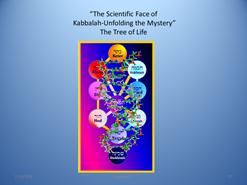
Unlocking the Meaning of Kabbalah
Before we begin, one must realize Kabbalah is not a religion. Kabbalah,
we will come to learn in this treatise, is the science of the spiritual universe
and a guide to a meaningful, healthy, and purposeful life. It is a process of
how the cosmos works for the betterment of humankind.
However, there is a compelling argument that the intent of the original
Kabbalists—that is, Abraham and subsequent sages—was to try to explain
how the cosmos works and how humans should conduct their lives.
As we know, there was no concept of organized religion as we know
it today during the times of Abraham, Isaac, and Jacob. Interestingly, the
term “religion” itself was not present in ancient sacred texts like the Bible,
the Quran, or others.
In summary, while religious ideas and practices have ancient roots,
the formal concept of “religion” as a distinct category emerged relatively
recently in human history.
From a young age, the diversity of religions and their claims about
the true God has intrigued me. The question of how to navigate these
theological differences without compromising one’s path to heaven is both
profound and universal. In this manuscript, I aim not to sway anyone’s
beliefs but rather to present insights from ancient sources, including
the early Kabbalist sages and the Sefer Yetzirah. After reviewing the
information here, one needs to make up their minds about their belief
systems. I will present information from the early Kabbalist sages and
from Sefer Yetzirah, among other ancient sources to try to understand
the truth about the universe and the concept of God and that we are
all connected through the 2022 Nobel Prize award-winning concept of
entanglement.
The Kabbalists also described how humans are meant to live within
their environment by developing concepts based on Sefer Yetzirah, the
Old Testament (also known as the Torah or Hebrew Bible), and the
Zohar. Rav Isaac Luria and Rav Nachman of Breslov articulated other
insights. Many Kabbalists consider Kabbalah to be the inner wisdom
of the Hebrew Bible and the place where the Zohar and Torah are
intertwined.
It is worth mentioning here that the Bible was written in Hebrew
and Aramaic and subsequently translated into Greek, Latin, English, and
many other languages. There are approximately 60,000 manuscripts and
fragments from the Hebrew Bible alone. There are vast differences among
these manuscripts, which affect translations and interpretations. Even
though all Bibles have the same content, they do not read the same.
So, it is with caution that I state what the Bible says. Some may
disagree with the translations. There are also many different versions of
the Bible, including the Protestant, Catholic, and Jewish versions. These
versions differ in the number of books they include and in how they
interpret certain passages.
The Catholic Bible, for example, includes books that are not found
in the Protestant Bible. The Protestant Bible, on the other hand, does not
include these books, and some passages are interpreted differently.
In this book, I will use the Hebrew Bible. Since the discovery of the
Dead Sea Scrolls, it has been found that the Bible found there is over 99%
identical to the one used today. I will explore the connections between
the concepts and ideas presented in the Hebrew Bible and the Zohar,
and the latest discoveries and theories of science. I will also examine the
implications of these connections for our understanding of the universe,
the concept of God, and the nature of reality.
Sefer Yetzirah, also known as the Book of Formation, holds a central
place in Jewish mysticism (Kabbalah). While some early commentators
viewed it as a treatise on mathematical and linguistic theory, Kabbalists
recognized it as a key text in their tradition. The word “Yetzirah” translates
to “Formation,” distinct from “Briah,” which means “Creation.”
Formation vs. Creation: A Subtle Difference with Profound Implications
Indeed, the distinction between formation and creation carries
profound implications. Let’s explore this subtle yet significant difference:
- Formation:
• The concept of formation suggests that something arises from
something prior.
• It implies continuity—an unbroken chain of existence.
• In this view, an energy field, or some fundamental essence, always
existed—even before our current universe emerged 13.82 billion
years ago. - Creation:
• Creation, on the other hand, implies a radical beginning.
• It posits that something or someone emerged from No Thing—a
void, an absence.
• Creation invokes the notion of a divine act, a spark that ignited
existence.
 Kabbalahsciences